TALLAHASSEE, Florida- The state of Florida has made a bold change to its laws concerning
nudity at public beaches, and this one might ruffle some feathers.
Beginning August 1st, full nudity will be legal at all public beaches –
as long as you obtain a Florida State Nudity License (FSNL).
I see bad behavior coming not good people drinking on the beach drug use rapist sexual Monsters Neighborhood Sex Offenders Pedafiles Governor Rick Scott approved the bill passed by the state legislature
making public nudity at state-owned beaches legal, and he encourages
tourists and residents to make use of new law. “Today is a great day.
Not only will it be legal to hang out at the beach totally nude, but we
encourage you do to so,” Governor Scott said. “As long as you are a
fairly attractive person, nobody is going to complain.” One part of the new law, which may be infuriating to some, is the
weight limits for those who may strip down completely. “If you are
overweight by more than twenty pounds, you will not be given a license.
You will be politely asked to go on a diet and come back at a later date
to try again. It really is not that complicated.” Scott said. “We want
everyone to enjoy this. Obtaining a license will not be hard for those
who meet all of our standards, and it will be a quick and easy process.
Residents and guests in the state may visit any of our town halls, where
we will have employees trained to record the weight of those wishing to
go nude. You will also be asked to submit a picture of your face and
genitals. If you’re not too ugly or fat, then they will issue you a
license for a fee of only $10, which will be good for 1 year.”
San Francisco Officials Approve a Ban on Public Nudity
The San Francisco Board of Supervisors voted 6 to 5 on Tuesday to approve a ban on public nudity. The vote means that there will be no more lounging nude in the city’s plazas, parading up and down city streets sans pants or riding subways and buses bare-bottomed.
Scott Wiener, a city supervisor who represents the Castro district, introduced the ordinance after an increase in the number of habitual nudists and a rise in complaints from residents and business owners.
“The nudity situation in the Castro has become extreme,” Mr. Wiener told his colleagues.
After city supervisors approved the ban, the crowd at City Hall erupted in loud heckling and booing.
“Recall Wiener! Wiener is a Republican!” shouted Gerhart Clarke, 55, who stood up along with half a dozen others and stripped down to the buff.
“Shame on you!” another woman yelled, pulling off her shirt. “What are you afraid of?”
Anticipating the nude protesters, sheriff’s deputies draped them in blue blankets and led them out of the meeting hall.
Under the new ordinance, public nudity will be subject to a series of fines. A first-time violation would result in a fine of up to $100. A second citation in the same year would cost up to $200, and a third would result in a fine of up to $500 or a misdemeanor and up to one year in jail.
On most sunny or even moderately warm days here, a handful of naturalists (known locally as “the naked guys”) can be found reading newspapers or stalking around the Castro district’s Jane Werner Plaza looking like an out-of-place flock of pale and ungainly birds.
The law will not go into effect until after Feb. 1, which will allow enough time for a federal judge to consider a lawsuit brought against the city by a group of nudists who claim that the ordinance infringes on their constitutional right to free speech.
As long as it is not lewd or offensive, public nudity is legal under state law. But on Tuesday, San Francisco joined many other cities that prohibit it, including nearby San Jose and Berkeley.
This is a city that prides itself on its inclusivity and diversity and, in that vein, the ordinance does allow for some exceptions.
Preschoolers can still go bare, women can still go topless and public nudity will continue to be allowed at events permitted by the city, including the annual gay pride parade and the Folsom Street Fair, a street party billed as the largest leather and fetish event in the world.
Several supervisors adamantly opposed the ban.
“I cannot and will not bite this apple,” John Avalos said before voting against the measure. “I refuse to put on this fig leaf.”
LLC 501C- 4 UCC 1-308.ALL RIGHTS RESERVED WITHOUT PREJUDICE
obamaobma at fault
RECALL: Ranbaxy Pharmaceuticals Inc. has recalled dozens of lots of its generic version of cholesterol drug Lipitor because some may contain tiny glass particles.
The company, India's biggest drugmaker is recalling 10-, 20- and 40-milligram doses of tablets of atorvastatin calcium.
Patients can contact their pharmacy to determine whether their meds were made by Ranbaxy or another generic drugmaker.
CORAL GABLES, Fla. — Now that the Obama and Romney campaigns have closed their headquarters in Chicago and Boston, the attention of the political world is shifting to an office suite tucked behind the colonnades of the Biltmore Hotel complex here.
The suite is where former Gov. Jeb Bush manages his consulting business, his education foundation and, now, the (very) early decision-making process for a possible presidential run in 2016.
When former President Bill Clinton rolled through here while campaigning for President Obama, he speculated about Mr. Bush’s intentions with Ana Navarro, a Republican strategist and friend of Mr. Bush. It was no idle topic for Mr. Clinton, given the possibility that his wife, Hillary Rodham Clinton, could seek the Democratic nomination.
When Senator Marco Rubio of Florida held a strategy session here to discuss his own political future last week, the question of Mr. Bush, a mentor, hung over the room; a decision by Mr. Bush, 59, to seek the Republican nomination would almost certainly halt any plans by Mr. Rubio, 41, to do so or abruptly set off a new intraparty feud.
Mr. Bush is said by friends to be weighing financial and family considerations — between so many years in office and the recession his wealth took a dip, they said, and he has been working hard to restore it — as well as the complicated place within the Republican Party of the Bush brand. Asked this week about whether his father would run, Jeb Bush Jr. told CNN, “I certainly hope so.”
For now, however, “It’s neither a ‘no’ nor a ‘yes’ — it’s a ‘wait and see,’ ” said Al Cardenas, the chairman of the American Conservative Union and a longtime friend and adviser to Mr. Bush. “It continues to intrigue him, given how much he has to share with the country.”
After Mitt Romney’s defeat by a Democratic coalition built around overwhelming support from Hispanics and other fast-growing demographic groups, many Republicans are looking for a candidate who can help make the party more inclusive without ceding conservative principles — and no one is the subject of more speculation at this point than Mr. Bush.
To his supporters, Mr. Bush is the man for the moment. His wife, Columba, was born and raised in Mexico. He speaks Spanish and favors overhauling the immigration system in a way that would provide a route to citizenship for people already in the country illegally but otherwise law-abiding.
Mr. Bush supports school choice and stricter performance standards, pitting him against teachers’ unions but putting him in league with Republican power brokers like the Koch brothers and Rupert Murdoch. Mr. Bush’s education project, the Foundation for Excellence in Education, has support from major party donors like the Walton family and the hedge fund executive Paul E. Singer, and has attracted support from the Bloomberg and Gates foundations.
Mr. Bush opposes abortion, and he is no less an opponent of higher taxes than his brother, President George W. Bush, was in his two terms. However, he has refused to sign the antitax pledge of the conservative activist Grover Norquist, who helped lead the rebellion against his father when the elder President Bush broke his own “no new taxes” promise during his first and only term.
He could also benefit from what some Republicans see as a modest vein of Bush nostalgia, marked by a video shown at the Republican National Convention about his father, who is 88 and contending with a form of Parkinson’s disease and declining health.
Any political future for Jeb Bush depends on whether that warmer tide will be enough to offset lingering bad feelings about the family brand after the presidency of George W. Bush, who continues to be criticized by many conservatives for presiding over bailouts and expanding the size of government.
Still, calls for Jeb Bush to enter the arena in a bigger way represent vindication of a sort. His family’s longstanding advocacy for a more broad-based and “compassionate” Republican Party was largely ignored and eventually repudiated by the populist, small-government conservatives who held sway over the party after Mr. Obama’s election.
George W. Bush’s break with the populist right began midway through his second term over his support for a pathway to citizenship for some illegal immigrants, which grass-roots activists labeled an amnesty plan. His push for immigration legislation failed.
This year, even before Election Day, Jeb Bush was warning of what he called his party’s “stupid” approach to illegal immigration. (Mr. Obama took 71 percent of the Hispanic vote, according to interviews with voters.)
“The day after the election, I started getting e-mails and texts from friends and others wanting Governor Bush to run and asking whether he would,” said Justin Sayfie, a Florida lobbyist who served as an adviser to Mr. Bush when he was governor.
The Patriot Conservative
News Tea Party Network
liberalism + Socialism = Terrorism Thanks for your Support
Electronic tracking: new constraint for Saudi women
A Saudi woman gets out of a car after being given a ride by her driver in Riyadh. Denied the right to travel without consent from their male guardians and banned from driving, women in Saudi Arabia are now monitored by an electronic system that tracks any cross-border movements.
Saudi women walk through a shopping mall in Riyadh. Denied the right to travel without consent from their male guardians and banned from driving, women in Saudi Arabia are now monitored by an electronic system that tracks any cross-border movements.
AFP - Denied the right to travel without consent from their male guardians and banned from driving, women in Saudi Arabia are now monitored by an electronic system that tracks any cross-border movements. Since last week, Saudi women's male guardians began receiving text messages on their phones informing them when women under their custody leave the country, even if they are travelling together. Manal al-Sherif, who became the symbol of a campaign launched last year urging Saudi women to defy a driving ban, began spreading the information on Twitter, after she was alerted by a couple. The husband, who was travelling with his wife, received a text message from the immigration authorities informing him that his wife had left the international airport in Riyadh. "The authorities are using technology to monitor women," said columnist Badriya al-Bishr, who criticised the "state of slavery under which women are held" in the ultra-conservative kingdom. Women are not allowed to leave the kingdom without permission from their male guardian, who must give his consent by signing what is known as the "yellow sheet" at the airport or border. The move by the Saudi authorities was swiftly condemned on social network Twitter -- a rare bubble of freedom for millions in the kingdom -- with critics mocking the decision. "Hello Taliban, herewith some tips from the Saudi e-government!" read one post. "Why don't you cuff your women with tracking ankle bracelets too?" wrote Israa. "Why don't we just install a microchip into our women to track them around?" joked another. "If I need an SMS to let me know my wife is leaving Saudi Arabia, then I'm either married to the wrong woman or need a psychiatrist," tweeted Hisham. "This is technology used to serve backwardness in order to keep women imprisoned," said Bishr, the columnist. "It would have been better for the government to busy itself with finding a solution for women subjected to domestic violence" than track their movements into and out of the country. Saudi Arabia applies a strict interpretation of sharia, or Islamic law, and is the only country in the world where women are not allowed to drive. In June 2011, female activists launched a campaign to defy the ban, with many arrested for doing so and forced to sign a pledge they will never drive again. No law specifically forbids women in Saudi Arabia from driving, but the interior minister formally banned them after 47 women were arrested and punished after demonstrating in cars in November 1990. Last year, King Abdullah -- a cautious reformer -- granted women the right to vote and run in the 2015 municipal elections, a historic first for the country. In January, the 89-year-old monarch appointed Sheikh Abdullatif Abdel Aziz al-Sheikh, a moderate, to head the notorious religious police commission, which enforces the kingdom's severe version of sharia law. Following his appointment, Sheikh banned members of the commission from harassing Saudi women over their behaviour and attire, raising hopes a more lenient force will ease draconian social constraints in the country. But the kingdom's "religious establishment" is still to blame for the discrimination of women in Saudi Arabia, says liberal activist Suad Shemmari. "Saudi women are treated as minors throughout their lives even if they hold high positions," said Shemmari, who believes "there can never be reform in the kingdom without changing the status of women and treating them" as equals to men. But that seems a very long way off. The kingdom enforces strict rules governing mixing between the sexes, while women are forced to wear a veil and a black cloak, or abaya, that covers them from head to toe except for their hands and faces. The many restrictions on women have led to high rates of female unemployment, officially estimated at around 30 percent. In October, local media published a justice ministry directive allowing all women lawyers who have a law degree and who have spent at least three years working in a lawyer's office to plead cases in court. But the ruling, which was to take effect this month, has not been implemented.
A selection from "On the Confederate Flag" 2nd Edition, December 2010.
This is one in a series of articles being featured on the Political Spectrum as part of Secession Week.
On the Confederate Flag
By Zach Foster
The Confederate flag, the republic for which it stood, and the entire
war fought over its legitimacy have made up a hotbed of passionate
debate for well over a century, and probably will remain so for another
fifty years to come. The flag itself is but a symbol, though to many
the interpretation and meaning of this symbol varies greatly, with
almost as many opinions on it as there are American citizens! Many
identify this symbol with racism, oppression, and terrorism, while
others identify it as a piece of long-passed history, while a few others
identify it with a lost yet noble cause. Feelings and arguments
regarding the Confederate flag and the causes for which it has been used
are reaching a new fervor on the eve of the 150th anniversary of the
Secession.
Despite the varying feelings of love or hate for the Confederate cause,
all can agree that the flag unquestioningly symbolizes the darkest
period in American history, when the bonds of brotherhood were forsaken
as friends and relatives became armed enemies. By no means is this
written work an apology or a defense of the Confederate flag, nor is it
an accusation or condemnation—it is simply an attempt to provide an
accurate and well balanced explanation of the symbol and what it really
stood for. It is with much hope that this presentation of facts,
opinions, and arguments will bring more clarity to what the flag really
stood for, and perhaps more people after reading this will be able to
find a little more peace and closure in regards to a long-ago war that
somehow manages to still divide Americans.
Identifying the flag
The first step to understanding the Confederate flag is to be able to
identify it—there were four flags flown all across the Confederate
States of America. The
first and most easily recognized Confederate flag is the battle flag,
consisting of two navy blue bars crossing over each other to make an X
(Saint Andrew’s cross). The X has thirteen white stars in it, which
represent the thirteen states the Confederacy claimed (though it did not
completely occupy all of them). This starry X lies over a dark red
field. This is the flag that flew on every Civil War battlefield along
side of or in lieu of the Confederate national flag. However, the
version of the battle flag seen today is actually a miscue of the
original battle flag. In all but a few cases the legitimate battle flag
was a perfect square, not the rectangular flag most see today. The
miscue of which I speak is a case of mistaken identity between the
square battle flag and the rectangular Confederate Navy jack. Somewhere
down the line, a Civil War re-enactor or Confederate enthusiast may
have adopted the rectangular naval jack, since the broader shape makes
it wavier in the wind and more appealing to the eye, and replaced the
sky-blue X with the navy blue X of the square battle flag.
There were three Confederate national flags, as the Confederate
government changed the flag twice. The first National flag is the Stars
and Bars, whose name is mistakenly given to the battle flag. The Stars
and Bars was the Southern answer to the Union’s Stars
and Stripes. This flag had three bars, two red and one white, and in
the upper-left corner was the blue field with seven white stars,
representing the seven states that seceded from the Union
in late 1860 and early 1861. The Stars and Bars would be revised to
hold six additional stars, four for the final states that seceded at the
start of the Civil War, and two for states the Confederacy claimed but
didn’t necessarily hold: Kentucky and Missouri
(the Confederate-occupied areas of the two contested states were
represented by underground legislatures). When the Stars and Bars was
carried into battle at the war’s start, it was noted that it was too
easily mistaken for the Union flag in the heat of battle, so it was
supplemented or replaced by the battle flag while a new national flag
was designed.
The second national flag, Stainless Banner, was significantly different
from the Stars and Bars. In the upper-left corner was a miniature
representation of the battle flag, and the rest of the flag was white.
This new national flag was by no means mistakable for the Union’s, but was soon altered because to many it looked like a surrender flag, due to seventy-five percent of it being white.
After revision, the third national flag had the same features as its
predecessor, but added was a large vertical red bar on the far right, so
that it couldn’t be mistaken as a sign of surrender. This was the
Bloodstained Banner.
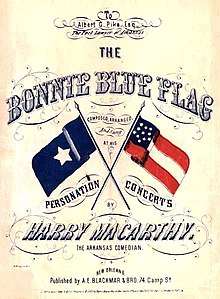
Some may be familiar with the Bonnie Blue Flag, which is a single large
white star centered over a dark blue background. This flag was a symbol
of Confederate patriotism. It had already served as the official flag
for the 1810 Florida Republic, and well as the Texas Republic flag. It was not new when the states seceded.
There were also Confederate state flags, as well as many variations of
the battle flag and national flags for individual Confederate military
units, but those need not be discussed. If any specific Confederate
military unit’s flag is being flown by a private citizen, that citizen
is most likely a professional re-enactor, a member of a historical
society, or a member of the Sons of Confederate Veterans.
What is a Confederacy?
The Confederate government was a special type of government not entirely common in the world. The United States
was a country of several dozens of semi-autonomous states, each with
its own government, which were overseen by and answered to the Federal
government. This federal government was the highest level of government
in the nation.
The Confederate system of government was the opposite. A confederacy is
a loose coalition of state governments. In the Confederate States,
each state governed itself and answered to no higher form of
government. The national government instead answered to the states, and
its main purpose for existence was to unite its eleven states as one
country with eleven sub-governments, in order to keep the states
autonomous without becoming eleven independent countries.
Unlike the United States,
whose national flag flew higher than state flags, the Confederacy’s
state flags flew higher than their national flag. The idea that a state
ought to answer to no higher government authority was the long-term
political reason for Southern secession. Many argue that the South
seceded for the right to keep slavery. This is partially true, but the
slavery issue was an economic issue in the South, not a political one.
Slavery
Nonetheless, it should be noted that the Union may not
have dissolved had the representatives from the Northern and Southern
states taken a realistic look at the possibilities of ending slavery.
Many of the Northern politicians were heavily influenced by the
abolitionist special interest while most of the Southern politicians
were plantation owners who relied on the institution to provide a labor
force. One clamored for the immediate end to slavery while the other
wanted to keep it forever.
The Confederate Constitution and most of its state constitutions
mentioned the right to maintain slavery, but it must be understood that
since the seventeenth century much of the Southern economy was deeply
entrenched in slavery and the removal of the institution would have
required a phasing out lasting several decades. If slavery were to have
been abolished overnight, the plantation-agrarian industry would have
taken a massive hit rivaling the recent corporate bankruptcies which
required the bailout of hundreds of billions of dollars in order to keep
these big corporations from going completely under and causing the loss
of countless thousands of jobs, more so than were lost leading up to
the bailout.
A much more efficient way to end slavery would have been a phasing out
as mentioned above. Over a period of thirty or so years, it may have
worked to slowly limit the breeding of slaves, then to limit the sale
thereof, then to slowly start freeing slaves and rehiring them as
laborers. Hiring plantation workers based on the hourly wage system
would have been more economically efficient because:
-As hired laborers, clothing wouldn’t need to be provided, cutting an expense
-Food wouldn’t need to be provided (for free), cutting another expense
-Instead of providing free housing to the workers, workers and their
families could live in plantation housing with rent being a fixed
deduction from their wages, cutting yet another expense
-Workers absent without leave could be fired or monetarily penalized
rather than plantation owners having to organize law enforcement or a
posse to go searching for fugitive slaves, saving a great deal of public
and private funds, as well as eliminating the need to remove men from
the labor force to do searches
-Workers could spend money not used on living expenses on the local
economy, thus strengthening the local economy and the free market system
-Business owners, after saving all of the above expenses, could either
create jobs or invest in the economy, thus strengthening the local
economy and the free market system
The social and moral benefits of a peaceful end to slavery would have
far outweighed the economic benefits. First and foremost, all Southern
blacks would have been treated as equals by their white counterparts (at
least within their social class), rather than just a minority of them.
Furthermore, the white/black antagonism of the Reconstruction and Jim
Crow era could have been completely avoided and Southern whites and
blacks could have lived harmoniously in a fraternal way rather than the
paternalistic way of antebellum times.
While the horrors of slavery are often blamed on the South, let it be
known that slavery was legal in a number of Northern states, and the
vast majority of ships specially built for slave shipping were built and
launched from Northern shipyards. Furthermore, tariffs on all imported
items, slaves included, were paid to and collected by the federal
government. Let it be understood that no one’s hands are clean in
regard to the institution of slavery, neither North nor South.
First image used courtesy of b36thillinois.org. Second image used
courtesy of Wikipedia. Images are used via fair use and are the property
of their respective owners, not the article author.
Zach Foster: On the Confederate Flag, Part 2
This is one in a series of articles being featured on the Political Spectrum as part of Secession Week.
From “On the Confederate Flag” 2nd Edition, December 2010
By Zach Foster
Political Correctness and the Myth of the White Confederacy
Though a great majority of the soldiers in the Confederate armed forces
were Caucasian, by no means should the ethnic minorities who called
themselves Southerners be omitted from mention. Historical records and
unit rosters show that between 50,000 and 80,000 African-American men
fought in gray uniforms. Ironically enough, the first African-American
military unit in American history was the First Louisiana Native Guards,
formed in 1861 and disbanded in 1862 when Louisiana was re-conquered by
the Union (the first United States Colored Troops weren’t formed until
January of 1863). Only ten to twenty percent of the black Native
Guardsmen switched sides. The overwhelming majority of them remained
Confederate patriots. Throughout the course of the war over 10,000
Native Americans and 5,000 Hispanics fought in gray. The latter
statistic only includes those who did not pose as white men.
Though slavery existed throughout America—it was simply a fact of
life—it would be ludicrous to say that every single black man or Native
American or Hispanic was a slave, forced by a white master to fight in
his stead. Despite its many shortcomings in social advancement, there
was much diversity among the Confederate states, though the Anglo-Celtic
culture was dominant. In 1861 two Mexican states offered to secede
from Mexico and join the
Confederacy. Though the offer was tempting, Jefferson Davis turned
their governors down, since he couldn’t afford to lose the much-needed
Gulf ports operated by the French, who ruled colonial Mexico
at the time. Some Mexican citizens looking for opportunities to
advance themselves financially or socially went north to fight as
Confederate Army or Texas Militia soldiers. No small portion of the
Hispanic rebel soldiers were Cubans from Florida. To this day no one knows how many black rebel soldiers were Dominican.
Many
would wonder why so many Hispanics would fight for the Confederacy if
they were often treated as second class citizens? First and foremost,
war has historically offered young men the opportunity for adventure
and, if they could make heroes of themselves, social advancement. The
second and especially powerful reason that many Hispanics were eager to
join the rebel army is because they simply had no love for the United States. Many of the Cuban and Spanish ethnic groups of Florida were never happy about being sold into the United States
by the motherland and then greeted as citizens by a military occupation
in 1821, only to be caught up fifteen years later in the chaos of the
Second Seminole War. In regards to the ethnic Mexicans in Texas and New Mexico, this was a crop of men whose fathers most likely fought and died to keep those areas in Mexico in the Mexican-American War between 1846 and 1848 and they never forgave the United States for the conquest of northern Mexico
only thirteen years before. This reasoning explains how many ethnic
minorities enlisted—military service during a time of war offered them
adventure and opportunities to climb ladders that wouldn’t have come
otherwise, fueled by grudges against the United States.
Of the estimated one million-man-strong Confederate armed forces, nearly
a tenth of the personnel were documented non-whites. This doesn’t
include the thousands of fair-skinned soldiers who passed for white.
Though they were a minority in the military, at least one third of the
Confederate civilian population was African American—slaves mostly—yet
the overwhelming, almost complete majority of Confederate voters were
white. The requirement for voting was to be a male land owner. By
these standards, over ninety percent of white men did not even qualify
to vote. A fact often overlooked is that Southern America
was a class society. The bottom class consisted of slaves. Above the
slaves were the impoverished free people—this class accounted for most
Southern whites and nearly all free-people of color (this was the
politically correct term of the time) who labored to earn their living.
The next class consisted of merchant shopkeepers, or non-wealthy people
who were lucky to own some land. The top class consisted of the
planters, who owned much land and many slaves.
A minority of non-white plantation owners existed, but few were former
slaves. Most had inherited their possessions and status as wealthy
descendants of black Frenchmen (Creoles) and Spaniards who had achieved
noble status before the Louisiana Purchase of 1803, or
the descendents of wealthy Hispanics who achieved nobility before the
Treaty of Guadalupe Hidalgo was signed. Any Native Americans who held a
high status were most likely born into the elite within their tribes,
or were descendants of a union between a Native American and US citizen.
Native Americans are a fascinating ethnic group to study in the context
of this time period. The vast majority of Native Americans who
participated in the Civil War fought for the Confederacy, as well as
many nonaligned tribal nations that fought independently against the United States.
The most notable union whose vast majority fought for the Confederacy
was that of the Five Civilized Tribes (Cherokee, Chickasaw, Choctaw,
Creek, and Seminole). The traditional Cherokee High Chief, John Ross,
sided with the Union in the opening months of the
conflict, disassociating himself and trying to disassociate the Cherokee
nations with renegade Chief Stand Watie. Oddly enough, the American
Civil War broke out in time to engulf a civil war between the Cherokee.
Before 1862 came along, Stand Watie was the leader of the majority of
Cherokee. Watie was made a Brigadier General in the Confederate Army,
leading his people to fight the Union Army and Union tribal warriors in
the West. Watie also drafted every able bodied Cherokee male between
the ages of seventeen and fifty into Confederate military service.
Watie’s forces were among the last to surrender in June of 1865. All
Native American Confederates fought especially hard, knowing after well
over a century of Ango-Indian wars that they had everything to lose.
Native Americans were the group whose grievances against the United States
most likely far outweighed all others’. This was especially true for
the Seminoles, who by 1858 (three years before the Civil War) had lost
their third war against the U.S.
There were many other tribes that were caught up in the war, or capitalized on it. The Sioux nation in Minnesota
came together in a major uprising that tied up Army units for five
months, resulting in the deaths of 100 tribal warriors, 100 soldiers,
and hundreds of civilian Natives and settlers. Out in the West, there
were dozens of tribes that loosely and independently aligned themselves
with one side, North or South, firing on their and their ally’s common
enemy during chance encounters (especially in the Arizona and New Mexico
territories). There were also tribes (like the Apaches, for example)
who fired indiscriminately at any Anglo soldiers they encountered.
Throughout the war years and the antebellum years, thousands of slaves
were owned by Native Americans.
Many poor Southerners did aspire to own land and slaves, including black
and Hispanic citizens, since to own land and slaves was a sign of
wealth and social status. Slaves especially were a good commodity to
own, since the ownership of slaves was more prestigious than the
ownership of land. Any man who owned a slave was well respected, and
the various blacks and Hispanics who owned both land and slaves were
treated as equals to their white counterparts. Slavery is an immoral
institution regardless of what race claims ownership over what other
people; but this is just the way life was back then, and the acquisition
of human property was tolerated as a sign of prosperity.
It just happened that the majority of slaves were in the South because
the need for them to work the land far outweighed the need for their
labor in the industrial north. Despite the large abolitionist sentiment
in the North, it is often overlooked that many wealthy people owned
slaves in the North, and most kept their slaves until the surrender of
Confederate forces in 1865. The Emancipation Proclamation of 1863 freed
only the slaves in occupied rebel territory, but not those in the
states still loyal to the Union. Northern slaves were
freed in 1865, while Southern slaves were freed as Southern territories
fell to the Northern Army. Again, slavery was wrong, but it was simply
an everyday fact of American life.
The first image is considered to be in the public domain, courtesy of Flickr.com. The
second image is used courtesy of Rebelstore.com. The men in the photo
are soldiers from the 3rd Texas Cavalry, CSA. They are from left to
right: Refugio Benavides, Atanacio Vidaurri, Cristobal Benavides and
John Z. Leyendecker. Images are used via fair use and are the property
of their respective owners, not the article author.
LLC 501C- 4 UCC 1-308.ALL RIGHTS RESERVED WITHOUT PREJUDICE